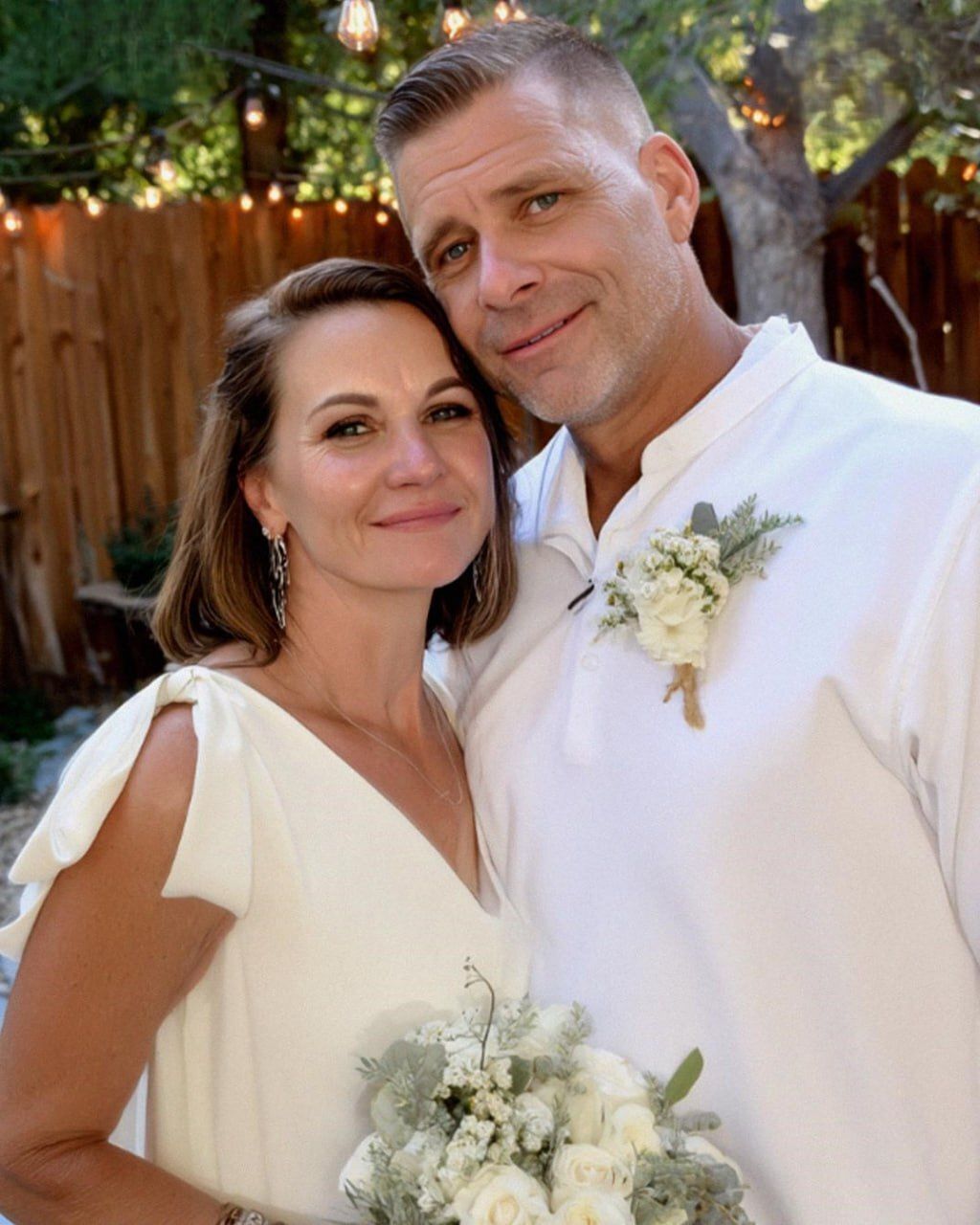
When Daniel asked me to marry him, I truly believed the worst chapters of my life were already behind me.
Grief had hollowed me out once. It had taken the air from my lungs, the certainty from my future, and the man I thought I would grow old beside. I had survived that. Or at least, I had learned how to function around the absence it left behind.

I was forty-one years old, standing in the middle of a life I never imagined choosing—but one I had slowly, quietly learned to inhabit.
For twenty years, I was Peter’s wife. Not the storybook kind with dramatic gestures and constant romance, but the kind that builds over time. The kind rooted in shared grocery lists, late-night talks after the kids were asleep, and arguments that ended in laughter because neither of us could stay mad very long.
We lived in a four-bedroom colonial that creaked when the weather changed. The back porch always needed fixing, and Peter insisted every spring that he would finally repair it himself. He never did it quite right. I pretended to be annoyed, but secretly I loved watching him try.
Our children filled the house with noise. Toys scattered across the floors. Shoes abandoned in hallways. Laughter echoing down the stairs. It was messy and loud and alive.
Peter used to call our life “ordinary,” and he meant it as praise.
Saturday soccer games. Burnt dinners we joked about while ordering pizza. Arguments over whose turn it was to take out the trash. He wasn’t perfect—he drove me absolutely crazy at times—but he was steady. Kind. Dependable. He made me feel safe in ways I didn’t even recognize until that safety vanished.
Six years ago, a drunk driver ran a red light on Peter’s way home from work.
I remember the police officer standing on my porch. I remember the look on his face before he spoke. And then I remember collapsing, my knees hitting the wood as my world split open.
The weeks that followed exist in my memory as fragments.
My daughter crying quietly in the bathroom, trying not to be heard.
My son retreating into silence, his grief turning inward and heavy.
Me standing alone in the kitchen at two in the morning, staring at Peter’s coffee mug still sitting by the sink, as if he might come back for it.
And through all of that, there was Daniel.
Daniel wasn’t just Peter’s friend. They were brothers in every way that mattered. They grew up three houses apart, survived college together on ramen noodles and questionable decisions, and once road-tripped across the country at twenty-two with no money and no real plan.
Daniel had his own complicated life. He’d married young. Divorced too quickly. He was doing his best to co-parent a little girl who deserved more stability than either of her parents had managed to provide. But he never complained. Never blamed his ex. Never painted himself as the victim.
I respected that about him.
After Peter died, Daniel didn’t ask what I needed. He didn’t hover or perform grief for attention. He simply showed up.
He fixed the garbage disposal Peter had been putting off.
He brought groceries when I forgot to eat.
He sat in the garage with my son, letting him work through his anger with a hammer and scrap wood instead of words.
He never made it about himself.
One evening, about four months after the funeral, I told him he didn’t have to keep doing all this. He was standing in the hallway replacing a lightbulb—something I could have done myself but hadn’t bothered to.
“I know,” he said, not looking at me. “But Pete would’ve done it for me.”
And that was the end of the conversation.
No hidden agenda. No emotional leverage. Just a promise kept.
The feelings didn’t arrive dramatically. There was no moment where I suddenly realized I was in love again. They crept in slowly, quietly, disguised as comfort.
Three years passed.
My children were finding their footing again. My daughter left for college on the opposite coast, eager to prove her independence. My son moved west to study engineering, carrying his grief with him in ways I still didn’t fully understand.
I was learning how to be something other than a widow. Not moving on—just existing.
Daniel had pulled back during that time, giving me space I hadn’t even known I needed. But one night, my kitchen sink started leaking at eleven p.m., and without thinking, I called him.
He showed up in sweatpants and an old college T-shirt, toolbox in hand.
“You know you could’ve turned off the water and called a plumber in the morning,” he said, already crouched beneath the sink.
“I could’ve,” I admitted. “But you’re cheaper.”
He laughed, and something in my chest shifted.
There were no fireworks. No dramatic realization. Just the two of us in my kitchen at midnight, water dripping into a bucket, and the quiet understanding that I didn’t feel alone anymore.
Over the next year, we settled into something easy.
Sunday morning coffee.
Friday night movies.
Long conversations about nothing and everything.
My kids noticed before I did.
“Mom,” my daughter said one winter break, “you know Dan’s in love with you, right?”
I laughed it off. Told her we were just friends.
She gave me that look—the one that said she was suddenly the adult in the room.
“Mom. Come on.”
The truth was, I felt guilty even thinking about him that way. Peter had been gone for four years, and some part of me still felt like I was cheating just by imagining happiness with someone else.
But Daniel never pushed. Never rushed. Never asked for more than I was ready to give.
When he finally told me how he felt, it was quiet.
We were sitting on the porch, watching the sun sink behind the trees. Chinese takeout containers between us. A bottle of wine slowly emptying.
“I need to tell you something,” he said. “And you can tell me to leave and never come back if you want.”
My heart raced.
“I’m in love with you, Isabel,” he said softly. “I’ve been in love with you for a long time. I know it’s complicated. I know Pete was my best friend. But I can’t pretend anymore.”
I realized then that I had known. For months. Maybe longer.
“It’s not wrong,” I said quietly. “I feel it too.”
He looked at me like he was afraid I might disappear.
